
Beyond the aged care threshold: Navigating the transformation to home-based care

The transformation of aged care toward home-based models is one of the most significant shifts in the sector, presenting both exciting opportunities and complex operational challenges for executive leaders.
Australia’s aged care sector is no longer just “preparing for change”, we are actively living it! The transition to the Support at Home program, coupled with evolving regulatory frameworks and financial recalibrations, is fundamentally reshaping how we deliver care.
The goal is clear: older Australians overwhelmingly want to age in their own homes. While this rights-based, customer-centric model is a vital step forward, the road to sustainability is proving to be complex. Providers are navigating a period of profound operational and strategic transformation.
The Challenges of the Shift
This transition brings significant friction, particularly for providers balancing the logistical realities of major program overhauls with the need to maintain quality. Some of the primary pressures currently facing the sector include:
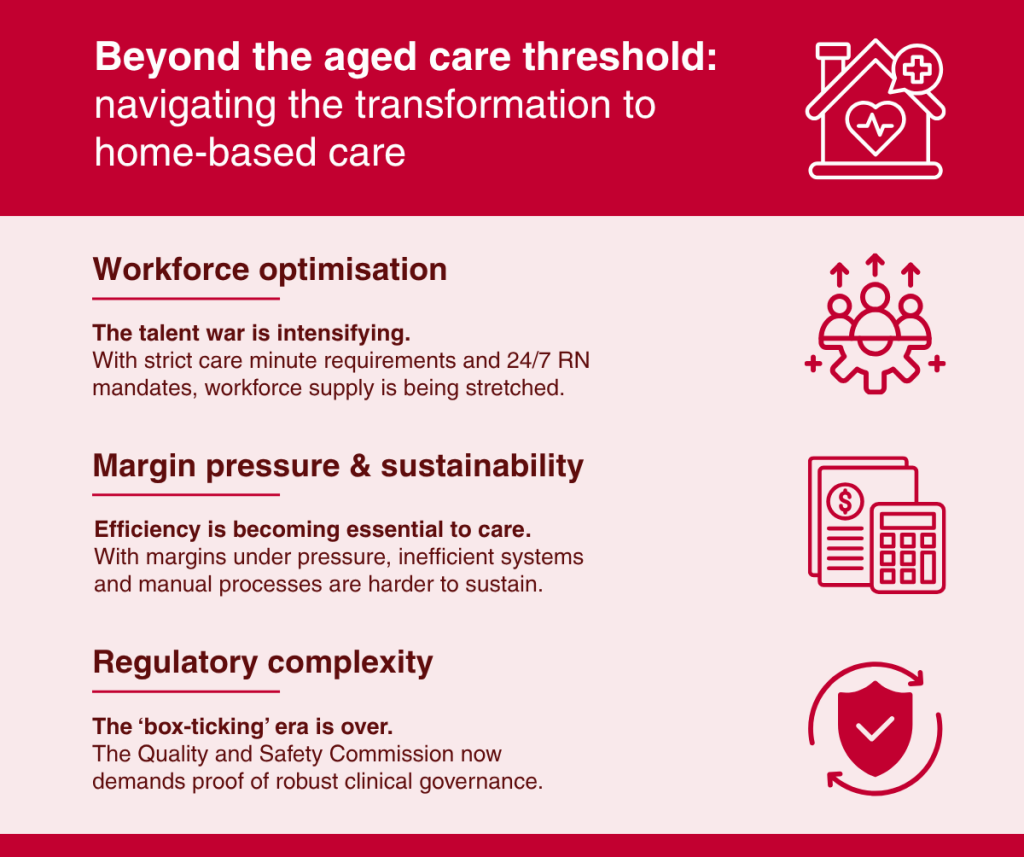
- Workforce optimisation: The talent war is intensifying. With strict care minute requirements and 24/7 registered nurse mandates, organisations are struggling to find the workforce supply to meet demand organically. The solution lies in moving beyond reactive recruitment toward structural workforce planning, leveraging predictive technologies and building stronger pathways with educational institutions.
- Margin pressure & sustainability: Price caps and the elimination of certain co-contributions are squeezing operational margins. Administrative overheads often trapped in siloed or manual systems are no longer sustainable. Providers are realising that efficiency in the back office is a direct requirement for protecting frontline delivery.
- Regulatory complexity: The “box-ticking” compliance era is behind us. We are moving toward a maturity-based model where the Aged Care Quality and Safety Commission demands proof of robust clinical governance. For Boards and C-Suites, this means personal liability and governance failure are real risks, requiring a shift toward real-time data pipelines and genuine “care literacy.”
From Survival to Sustainability
In my opinion, the providers that will thrive in this environment are those who view these reforms not as an exhausting compliance exercise, but as a baseline for innovation and improvement.
I believe success in the new landscape depends on the mutual reliance of three key pillars:
- Digital transformation: Scaling back-office automation to free up resources for frontline care.
- Proactive governance: Moving beyond static checklists to use AI and asset intelligence for predictive risk management (e.g., falls prevention or early deterioration detection).
- People-first culture: Building an “employer of choice” culture that prioritises psychological safety, allowing staff to flag risks without fear.
The merging of Aged Care and Disability services, driven by similar funding models and the shared challenge of decentralised delivery, suggests that the sector’s future lies in integration and cross-sector collaboration.
Let’s Discuss
As we navigate this new landscape, I’m interested in hearing from my networks: How is your organisation managing the transition to the Support at Home program? Are you finding that the focus on digital infrastructure is helping you navigate these regulatory and financial pressures?
Share your thoughts in the comments below, or reach out if you’d like to discuss the leadership strategies required to manage this transformation at alex@johnsonrecruitment.com.au or barry@johnsonrecruitment.com.au or call Alex on 0472510848 to discuss further.
READ MORE